Services
Epilepsy and Seizure Disorders
Epilepsy and Seizure Disorders
What is a seizure?
A seizure (fits or convulsion) is a sudden, brief disrup on of normal brain ac vity.
Will it occur in all people?
Epilepsy can affect anyone, of any age or race, male or female, from any age of life and may:
- Develop shortly a er birth due to complica ons.
- Begin in childhood, e.g. febrile convulsions, childhood illnesses.
- Occur in different genera ons of the same family.
What are the types of seizure?
The seizure may have different forms depending on whether this happens in all the brain or if the seizure is in a part of the brain.
There are two types of seizure:
- Generalized seizure.
- Focal seizure
- Generalized seizures - In generalized seizures large areas on both sides of the brain are affected & consciousness is o en lost. Seizures in this category include:
- Absence seizures: the person looks blank for a few seconds and may not respond when spoken to or realize they have had a seizure. This type of seizure can happen repeatedly and can be mistaken for daydreaming.
- Tonic-clonic seizures: the person s ffens, then jerks, loses consciousness and may fall. They may also pass urine or mo on without control.
- Tonic and atonic seizures, or drop a acks: The person may s ffen and fall heavily or lose muscle tone and fall to the ground.
- Myoclonic seizures: rhythmic muscle jerks that can affect a part or the whole body and can be strong enough to throw the person to the ground.
- Focal seizures During focal seizures only part of the brain is affected and consciousness may be altered but not lost.
AURAS (or warnings): Some people experience a particular
- Smell or
- Sound or
- Feeling before a seizure starts. It is itself a focal seizure.
- Focal seizures with awareness fully retained: the person may experience unusual sensa ons or movement in one part of the body, e.g. ngling or twitching. This is also some mes called a simple focal seizure.
- Focal seizures with awareness reduced or lost: the person may experience strange feelings and awareness may be disturbed or lost. They may be unaware of their surroundings, unable to respond and their behavior may appear unusual. This is also some mes called a complex focal seizure.
Some focal seizures can evolve spreading to both sides of the brain. This can result in a focal seizure evolving into a convulsion, which may look like a generalized tonic-clonic seizure.
- Unclassified seizures: Some seizures are unclassified, i.e. they don't fit into any category. Others occur as part of a syndrome - a set of symptoms occurring together - par cularly in childhood.
Following types of seizures require urgent medical care
Serial seizures: Occur one a er another without full recovery in between.
Prolonged seizures: Last over two minutes or five minutes longer than usual.
Convulsive status epilep cus: Last for 30 minutes or more without a return to normal breathing or full consciousness.
Non-convulsive status epilep cus: Occur in non-convulsive seizures, e.g. absences and focal seizures.
Most people with epilepsy achieve effec ve seizure control with an epileptic drugs (AEDs), although some mes surgery or a special diet may be recommended.
Following types of seizures require urgent medical care
- Missing doses of an-epileptic medication.
- Poor sleep.
- Stress.
- Fever.
- Tumors.
- Genetic factors.
- Alcohol.
- Some medica ons used for other diseases eg: an bio cs (only few, not all).
- Flashing/flickering lights (this is known as photosensi ve epilepsy).
- Brain scarring or brain damage, e.g. birth injuries, accidents, physical assaults, infec ons, stroke.
- Hormonal changes e.g. puberty, pregnancy, menopause.
Following types of seizures require urgent medical care
- Avoid any triggers / causes you may have identified.
- Try to live a healthy lifestyle, with a good diet and adequate rest.
- Let people know where you are and when you expect to be back.
- Tell the pool attendant if you go swimming, or go with someone that knows what to do if you have an attack.
- Avoid activities where it would be difficult to get help to you.
- Avoid unprotected heights and unsupervised areas of water.
- No smoking & no alcohol drinking.
- Avoid excessive stress, sleep depriva on and redness.
- Wear a helmet when cycling and avoid main roads.
Following types of seizures require urgent medical care
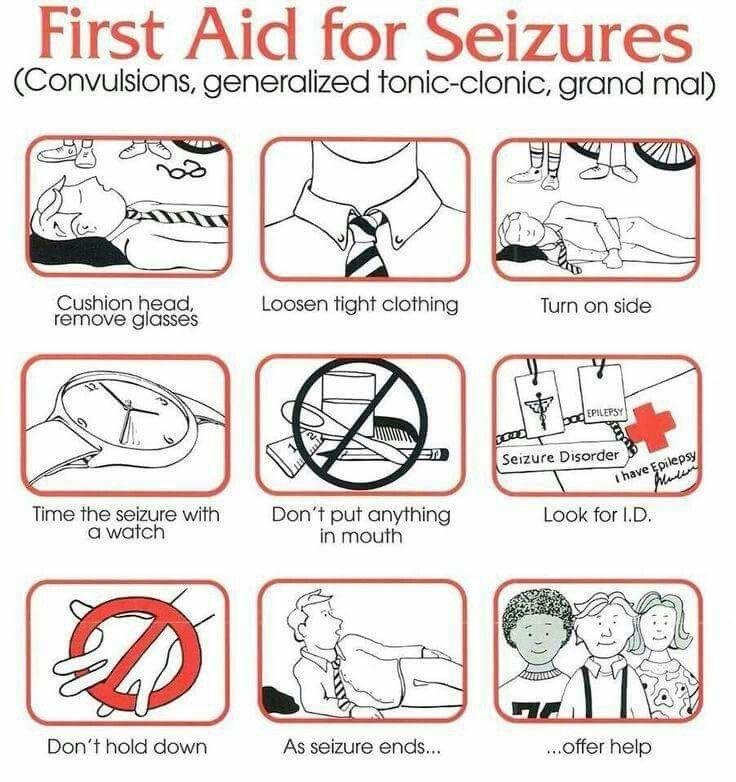
Do's
- Once a seizure starts, it will usually stop on its own a er a few minutes.
- Watch the seizure carefully and if possible let it run its natural course.
- Keep calm and note the me the seizure starts and how long it lasts.
- Protect the person from injury. Clear a space around the person, removing any sharp, hot or hard objects. If they are confused, guide them away from danger such as stairs or a road.
- Cushion the person's head with whatever is available.
- Loosen any ght clothing round the neck and gently remove glasses if worn.
- Turn the person onto their side into the recovery posi on once the convulsions stop.
- Stay with the person, if possible, until any confusion passes.
- Gently reassure them as they recover.
After the seizure, if the person is unconscious, aid their breathing by rolling them onto their side and gently lifting their chin, tilting the head backwards (the recovery position) until they regain awareness.
DON'Ts
- Do not try to restrain the person.
- Do not put anything between their teeth.
- Do not move the person while the seizure is happening unless there is an immediate danger (e.g. in a busy road, at the top of stairs, in water, near a fire or hot radiator).
- Do not give the person anything to eat or drink until they are fully recovered.
- Do not give any medica on while the seizure is happening.
- Do not leave the person until they have recovered.
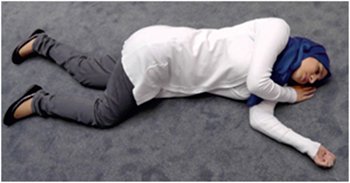
The Recovery Position
First make sure that the unconscious person can breathe and gently tilt their head back. Then follow the four steps shown to place them in the recovery posi on. Do not use this method if you think that the unconscious person may have damage to the neck, back or any part of the spine.
- Step one: Move the person's arm that's closest to so that it forms a right angle.
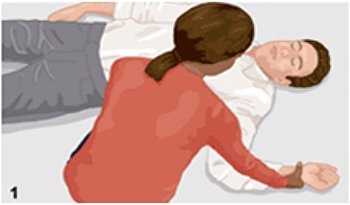
- Step two: Place the palm of the person's far hand on their opposite cheek, and bend their far leg so that it's at a right angle to their body. Then gently roll the person towards you onto their side.
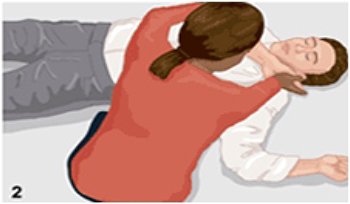
- Step three: Adjust the leg and hand positions as shown.
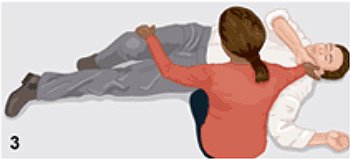
- Ensure that the person's head is still tilted back and that they are still breathing.
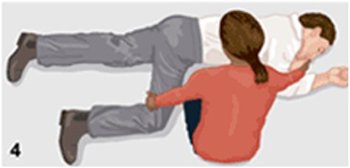
Final Recovery Position
When should I go to a hospital?
- One seizure follows another without any recovery in between.
- The seizure lasts longer than five minutes or the person remains unconscious for a longer me than usual.
- The seizure is a different type or pattern of seizure to what the person normally has.
- The person has been badly injured.
- The person has difficulty breathing.
- You do not know the person's history.
- Or you are at all unsure.
What do I do next?
- It is common to feel nervous and anxious about returning to normal activities, but your confidence will return.
- Follow any advice that you have been given regarding lifestyle and general safety, but try not to let this episode restrict your activities.
- Many people will never have another episode, however, if you do, contact your doctor as soon as possible who will be able to inves gate further.
- Frequent and/or severe seizures can impact severely upon a person's life, and they may even require constant supervision.
However, the majority of people with epilepsy respond well to treatment and they are able to con nue with their lives with a bit more caution.
What precautions should I take?
Cau on / avoid:
- Driving
- Swimming
- Dangerous work machinery
- Cycling on busy road
- Standing close to roads or train platforms.
- Consumption of alcohol.
- Sitting inside a locked room bedroom / bathroom.
- Use of bath/shower without supervision/someone else in the house.
- Using ladders What to do: Inform your employer that you have had a seizure.